Newsletter archives - Part 12
Plants as Adaptogens
Plants as Adaptogens: First PlantsThen People. Phytonutrients are found in the cells of plants and provide protection from the damaging rays of the sun.link A phytochemical is a natural bioactive compound found in plant foods that works with nutrients and dietary fiber to protect against disease. Phytochemicals fight to protect your health. They can have…
Pro-Inflammatory Omega-6s in Refined Vegetable Oils
Comparison of Omega-6 and Omega-3 Ratios in Cooking and Salad Oils Inflammation is a factor in pain and chronic disease. The omega composition of corn, safflower, and cottonseed is heavily weighted toward pro-inflammatory omega-6 oils. Corn, safflower, and cottonseed oils, as well as refined flour which is also inflammatory, are used extensively in processed foods.If…
Composition of Nut and Seed Oils
Nut or Seed: Super- Omega-3 (Table) Poly- Omega-6 (Table) Mono- Omega-9 (Low-Temp) Saturated (Cooking) Lauric Acid Flax 58 14 19 9 0 Olive 0 8 76 16 0 Coconut,unrefined 0 3 6 91 44 Palm Kernel 0 2 13 85 47 Sesame 0 45 42 13 0 Peanut 0 29 47 18 0 Rape (Canola)…
What Are “Good” Fats and Oils?
To understand fats requires knowing a little bit about their structure. When we can visualize this, we can appreciate why some fats are more stable and suitable for cooking. We can also appreciate the importance of omega-3 and omega-6 fatty acids: they are essential to obtain through foods since the body cannot itself make them….
Fats and Metabolism
Fats play an important role in weight loss, particularly by making us feel satisfied at the end of a meal. This is intuitive and empirical. And, there are a host of interesting concepts that come from the science lab that support the idea of using healthy, saturated fats for weight loss. Good fats not only…
Wheat: Varieties and Processing Methods
Comparing Wheat: Dwarf, Einkorn, Emmer, and Other Traditional Varieties In the past, some wheat hybridization occurred naturally, either through cross-pollination in the wild or in cultivated fields of yore, thus explaining the evolution of some varieties, for example, from Einkorn to Emmer. Einkorn is thought to be the oldest variety of wheat, with its wild…
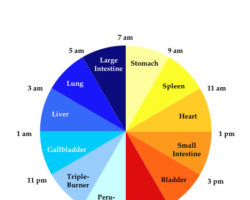
The Chinese “Body Clock”
The Body-Energy Clock is built upon the concept of the cyclical ebb and flow of energy throughout the body. During a 24-hour period (see diagram that follows) Qi moves in two-hour intervals through the organ systems. During sleep, Qi draws inward to restore the body. This phase is completed between 1 and 3 a.m., when…
March 2010: Cooking With Bones
To read this newsletter in its .pdf form, click here to download the file:March 2010 Newsletter. Thank you. In this newsletter Bones and Beans Bones and Meat Cooking with Bones Lamb Shanks Organic Turkey Necks Split Peas with Smoked Ham Hocks Traditional Recipes from the Original Fanny Farmer 1896 Cookbook Scotch Broth Ox-Tail Soup Braised…
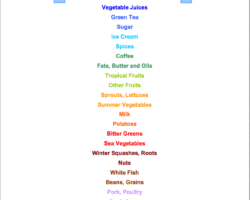
Expansive (Yin) and Contractive (Yang) Foods
Using Expansive and Contractive Foods to ModerateEnergy and Moods Foods and cooking strategies offer vast opportunities to alter our energy, our focus, and our moods. We can take corn, an expansive grain as illustrated below. Corn itself might make us a little on the spacey side. But, if we then grind it, add salt, and…
Chinese 5-Phase Foods and Moods
Click the image above to view the entire chart. Chinese 5-Phase Theory is my favorite food model because of its complexity and its potential for endless discovery and possibility. The 5-Phase model depicts foodeach with their own energy and relationship to specific organ systemswith the organ systems, parts of the body, and emotions and moods….